Tuesday, August 26, 2008

changing work

Some things I dislike about many jobs:
- hierarchy
- sitting still most of the day
- windows that don't open
- selling labor to managers/owerners
- throwing ethics out the window as soon as you get to work
- bad labor unions
- exploitative bosses
- extreme specialization
- using computers and phones so much
- competition with co-workers
- classism and sexism
- under-payment
- lack of benefits
- long work-weeks
- long commutes in cars
- away from friends and family

What I'd like to see more of:
- worker co-ops
- healthy buildings
- diversification of duties
- unions and bosses who are trying to increase equity at work, not get as much as possible for themselves
- active listening and consensus-building at work
- benefits for every worker
- living wages for all full time workers
- short commutes on bikes or feet
- full time reducing from 40 to 25 hours
- friends and family as co-workers, or at least "on site"

Wednesday, August 20, 2008

from the ground up


We imagine an issue as something we can separate out, with a beginning and ending: issues like child care, water pollution, gay rights, money's influence in politics, and so on. But actually, there are no issues, distinct and finite. There are only entry points into the network of life.
- Lappe & Perkins. 2004. You Have the Power, p.160.

The network: it's more than the network of life. It's the network of the universe and particle physics. It's the network of sociality. It's the network of sympathy. It's the network of history. It's the network of food, waste, and death.

Since I must enter and I must enter somewhere and some time, choosing something and starting it as soon as possible is the right decision. I don't know what the next step will be. I try not to get hung up on doing it right or the way someone else (such as Frances Moore Lappe) does it.

Derek Jensen says he can't/won't advise people what to do, because every great action is only great/right in chronotopic context; it won't work in another place and time, without appropriate adjustment for place and time (from an issue of Ascent magazine). This seems about right.

Just doing something can be a big deal for me and my sense of life and my place in it. It can be a big deal for others' senses of life and their place in it. It can be a big deal for how whole systems function. No matter what, it's all part of big systems' functioning.

Not doing my something feels stultifying, it's frustrating, it's deadening, it's unethical. Some things I sometimes do:
  • write a letter
  • have a pot-luck
  • ride a bike
  • turn off the air conditioning
  • display a political pin or sticker
  • boycott mainstream media
  • get outside
  • buy local
  • meet my neighbours
  • listen
  • meditate
  • speak from experience
  • eat fresh fruits and vegetables and whole grains
  • participate in my labour union
  • call out prejudice

Thursday, July 05, 2007

a creative, non-fiction activist writing

I like this. I first encountered it about a month ago in Best American Non-required Reading, 2005, edited by Dave Eggers.

Manifesto: A press release from PRKA
By George Saunders

Last Thursday, my organization, People Reluctant To Kill for an Abstraction, orchestrated an overwhelming show of force around the globe.

At precisely 9 in the morning, working with focus and stealth, our entire membership succeeded in simultaneously beheading no one. At 10, Phase II began, during which our entire membership did not force a single man to suck another man's penis. Also, none of us blew himself/herself up in a crowded public place. No civilians were literally turned inside out via our powerful explosives. In addition, at 11, in Phase III, zero (0) planes were flown into buildings.

During Phase IV, just after lunch, we were able to avoid bulldozing a single home. Furthermore, we set, on roads in every city, in every nation in the world, a total of zero (0) roadside bombs which, not being there, did not subsequently explode, killing/maiming a total of nobody. No bombs were dropped, during the lazy afternoon hours, on crowded civilian neighborhoods, from which, it was observed, no post-bomb momentary silences were then heard. These silences were, in all cases, followed by no unimaginable, grief-stricken bellows of rage, and/or frantic imprecations to a deity. No sleeping baby was awakened from an afternoon nap by the sudden collapse and/or bursting into flame of his/her domicile during Phase IV.

In the late afternoon (Phase V), our membership focused on using zero (0) trained dogs to bite/terrorize naked prisoners. In addition, no stun guns, rubber batons, rubber bullets, tear gas, or bullets were used, by our membership, on any individual, anywhere in the world. No one was forced to don a hood. No teeth were pulled in darkened rooms. No drills were used on human flesh, nor were whips or flames. No one was reduced to hysterical tears via a series of blows to the head or body, by us. Our membership, while casting no racial or ethnic aspersions, skillfully continued not to rape, gang-rape, or sexually assault a single person. On the contrary, during this late-afternoon phase, many of our membership flirted happily and even consoled, in a nonsexual way, individuals to whom they were attracted, putting aside their sexual feelings out of a sudden welling of empathy.

As night fell, our membership harbored no secret feelings of rage or, if they did, meditated, or discussed these feelings with a friend until such time as the feelings abated, or were understood to be symptomatic of some deeper sadness. It should be noted that, in addition to the above-listed and planned activities completed by our members, a number of unplanned activities were completed by part-time members, or even nonmembers.

In London, a bitter homophobic grandfather whose grocery bag broke open gave a loaf of very nice bread to a balding gay man who stopped to help him. A stooped toothless woman in Tokyo pounded her head with her hands, tired beyond belief of her lifelong feelings of anger and negativity, and silently prayed that her heart would somehow be opened before it was too late. In Syracuse, New York, holding the broken body of his kitten, a man felt a sudden kinship for all small things.

Even declared nonmembers, it would appear, responded to our efforts. In Chitral, Pakistan, for example, a recent al-Qaida recruit remembered the way an elderly American tourist once made an encouraging remark about his English, and how, as she made the remark, she touched his arm, like a mother. In Gaza, an Israeli soldier and a young Palestinian, just before averting their eyes and muttering insults in their respective languages, exchanged a brief look of mutual shame.

Who are we? A word about our membership. Since the world began, we have gone about our work quietly, resisting the urge to generalize, valuing the individual over the group, the actual over the conceptual, the inherent sweetness of the present moment over the theoretically peaceful future to be obtained via murder. Many of us have trouble sleeping and lie awake at night, worrying about something catastrophic befalling someone we love. We rise in the morning with no plans to convert anyone via beating, humiliation, or invasion. To tell the truth, we are tired. We work. We would just like some peace and quiet. When wrong, we think about it awhile, then apologize. We stand under awnings during urban thunderstorms, moved to thoughtfulness by the troubled, umbrella-tinged faces rushing by. In moments of crisis, we pat one another awkwardly on the back, mumbling shy truisms. Rushing to an appointment, remembering a friend who has passed away, our eyes well with tears and we think: Well, my God, he could be a pain, but still I'm lucky to have known him.

This is PRKA. To those who would oppose us, I would simply say: We are many. We are worldwide. We, in fact, outnumber you. Though you are louder, though you create a momentary ripple on the water of life, we will endure, and prevail.

Join us.

Resistance is futile.

Tuesday, April 17, 2007

good news

The Bangou Slavery Memorial has raised the money it needed. Yay!

Sunday, January 28, 2007

alternative "development" projects


Not too far from the town of Bangangte, there is a small village called Bangou. A friend of mine is a Peace Corps Volunteer there. She has a new project to help the townspeople fund and construct a Memorial of the Atlantic Slave Trade. She tells me that many residents of Bangou feel terrible remorse for their ancestors who sold Africans into a slave trade which was far worse than they imagined, and for the Africans who were sold, suffered, and died as slaves. They also are afraid that the spirits of these former slaves are angry and vengeful. The memorial will be a way to heal all these wounds. If you're interested in contributing money, or just learning more, click on the phrase "Bangou Slave Memorial" on the left side of this blog. [This link has been removed.]

Wednesday, September 27, 2006

plans


Well, plans have a way of changing, and mine are no exception. I left Cameroon early and am now taking it easy in Scarborough. Some of you know I was tentatively planning another tropical expedition unrelated to my research for early this year, but now I don't expect to leave the continent of North America any time soon. When I'll be relocating to Ann Arbor is still unknown, but I expect it will be between May and September 2007.

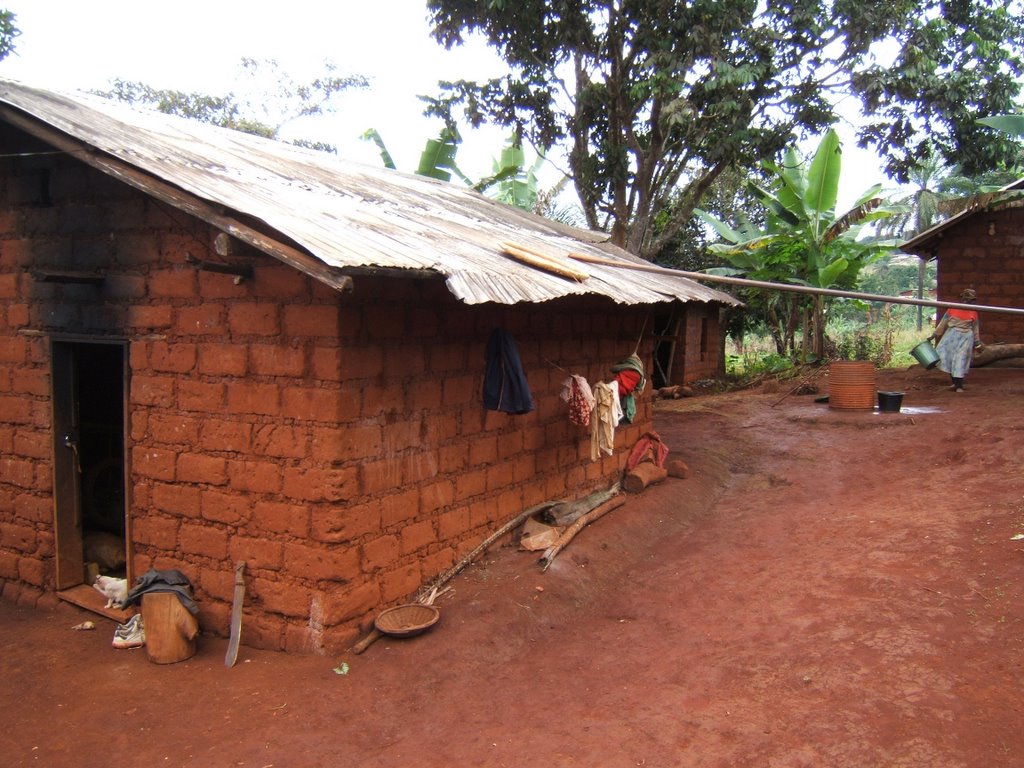
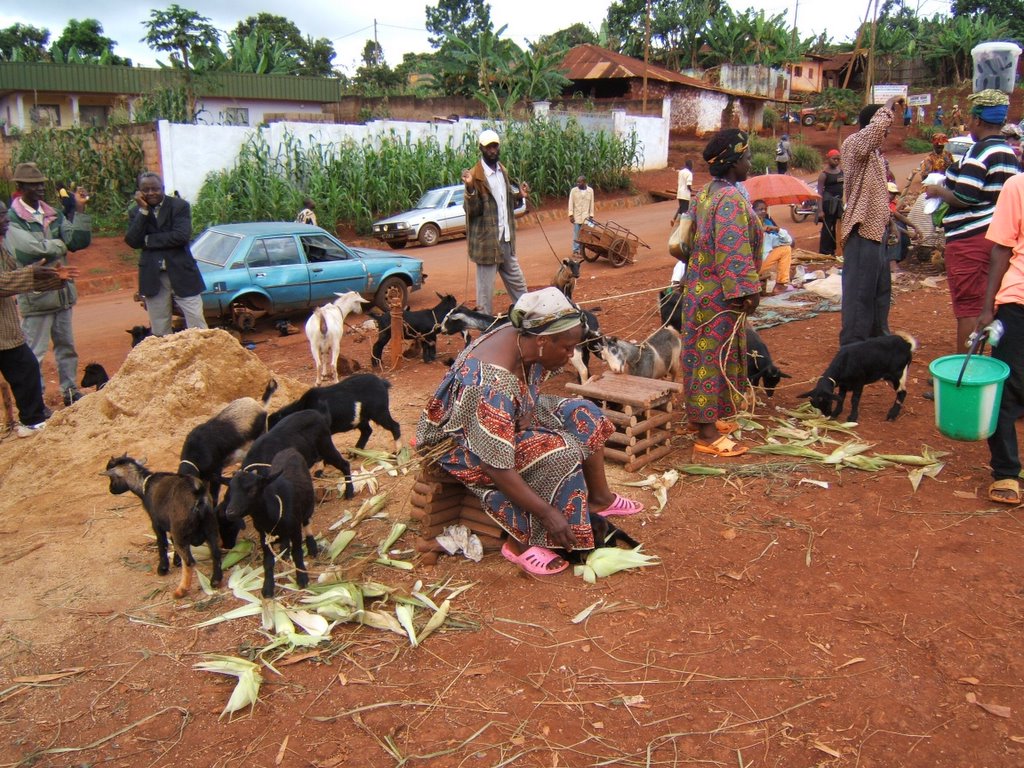
What will become of this blog? I don't know. Eventually, I will get around to posting more photos of Bangangte here - that's for certain. I might keep it as a regularly updated blog concerning whatever happens to be going on with me: a way to disseminate news. That would require changing some of the blog settings, which is not a big deal. So, we'll see. Thanks for reading so far. (Yes, this photo was taken in Bangangte.)

Tuesday, August 08, 2006

many facets


A lot of anthropologists who work in former colonies encounter a great deal of suspicion and disapproval in the field. The locals, of course, had decades of oppression, dishonesty, and betrayal at the hands of white people with questions, tape recorders, and clip-boards; one can understand being wary today. I, however, have not encountered much of that. Most people are dying to participate in my study, give their opinion etc. Presumably, though, there are people who don't feel good about me doing a study in Bangangté, but who just stay quiet or avoid me. There is one guy who comes into the coffee shop regularly, who is not like this; he lets everyone know exactly what's on his mind. When he's having a bad day, he more or less tries to find just the right way to bother everyone else there. With me, he blames me personally for the systematic exploitation of Africa by Europe and North America for the past several centuries, or he tells me all the reasons I'm a terrible anthropologist. In all honesty, the guy is clearly pretty unhappy; he hates Europe and he hates Africa; he has lots of big ideas about changing the world and making a living, but he's broke and unemployed. Other people think he's borderline insane.

Today, I saw him and asked him if he'd like to do one of my informal interviews. I wondered if he might just refuse or start making fun of me. Instead, he lit up like a Christmas tree - clearly thrilled to have been asked. Maybe I got him on the right day, maybe he's thirsty for someone to take him seriously, maybe both. He especially enjoyed telling me why he likes jazz (which he was exposed to during university); he sees it as importantly connected to the liberation of black people. I believe it was a satisfying exchange for both of us, and he was very appreciative of the cash gift I give to everyone who participates.

Thursday, July 13, 2006

further developments


What happened in the aftermath of three musicians quitting that group? The board members had a talk with me and explained their rationale for the rule: if loyalties are thinly divided, they fear that no one will take responsibility for anything. They also said that, since I'm just a visitor, the rule doesn't apply to me; I can do what I want, as far as they're concerned.

However, the musicians themselves said petty jealousy was the real explanation for this rule, and, furthermore, that it would be inappropriate (as in, socially weird, a faux pas)for me to both stay with the first group and join a new group. They said that it was my decision and that there would be no hard feelings regardless of which direction I take, but that I must choose between them. I objected in vain. I'm not going to leave the first group, but I haven't given up hope of getting to know the new group. Last night, on the spur of the moment, they invited me to perform with them, which I did. And, by coincidence, one of their dancers is a server at a restaurant I frequent.

Both the drumming and the dancing they displayed were fantastic - a significant cut above the average, it seemed to me (the musicians themselves don't mind telling me that they hold their own playing in the same high esteem). Most of them have been gigging musicians since the age of ten. They launched right in at break-neck tempo, eschewing the typical practice of slowly increasing speed as excitement builds among the assembly. Even to play maracas with these folks was both a thrill and an honour.

And what has happened for the original group in performance? They have some new people who, to my ear, are certainly not as good. Second - and surprisingly - one of the guys who supposedly quit returns for performances, but doesn't attend regular meetings! In other words, he's still breaking the rule, everyone seems to know it, but no action has been taken yet.

can't resist


Two or three months ago, I performed with an ensemble at an opening ceremony-of-sorts in Bangangte. Lots of townspeople were in attendance. What I didn't notice was that someone was videotaping the proceedings. Last week, as I walked into town in the morning, several of my friends stopped me to ask if I'd watched TV the night before. It turns out that exerpts from this opening ceremony had been broadcast on national television (a channel called "CANAL 2") to advertise the Medumba Cultural Festival which opened in Bangangte on July 8th. My maraca-playing had been featured and now people all over the country know there's a foreigner in Bangangte who can play "traditional" music. One of my friends in the Peace Corps says I'm becoming a Bangangte rock star.

Tuesday, June 13, 2006

some drama


At these groups I go to, there are usually a handful of people who are what I call "vocational musicians" - mastered all the parts in the ensemble, familiar with several types of music, and play with a number of groups - and a large number of people who can play some of the instruments, but not all, and are poor soloists. (Actually, it's not rare for someone to able to play one and only one part.) Well, at one of my groups, there was a decision last week by "the board" that it was inappropriate for members to play music with more than one group. In this group, there are 4 vocational musicians; 3 of them (including the group's music director) decided to quit, taking it as an insult and an absurdity that multiple membership would be frowned upon.

From my perspective, this has pretty-much gutted the musicking potential of this group. I suspect that it will be possible for them to replace the members who quit, but also that it will be very difficult to find people that good who are willing to abandon other groups they may be associated with. I hope to be allowed to attend another group with these 3 who quit (aside from being inspirational players, they're super-sweet guys) and keep attending the first group's meetings. I'm curious to see what the first group will do about upcoming gigs.

It's not directly relevant to these developments, but I thought it might be interesting to say a few words about the gendering of music around here. I know of zero female vocational musicians. A good number of women can play background parts in their groups. I have never seen a woman take a solo on an instrument [since time of writing, I've seen one female drummer soloing]. Singing and dancing, unlike instrument-playing, seem to be equally open to both men and women. Whether men or women sing about different things, or in different styles, or at different times are questions I might be able to answer later after analysis of my data at home.

Saturday, May 13, 2006

ceremonies


My parents have almost finished a two-and-a-half-week visit here. We are having a great time. The two music groups I'm with regularly, and my landlord's family all created little ceremonies on three separate occasions. All three of us Canadians played instruments and danced, and my parents were given gifts - pottery, fancy bags, and clothing. My regular music teacher was amazed - even shocked - at the abilities of my musical family.

At one of the ceremonies, I was officially inducted as a member of the "orchestre" and was given the shirt we're supposed to wear at performances. I was also fined (about one dollar) for having missed a performance during my parents' visit.

Tuesday, March 28, 2006

real work


I've started in doing the transcription of another musical event I recorded. The guy I'm working with is very forthcoming with in-depth explanations and background information on the Medumba poetry we're translating into French.

There are 2 singers this time, and it's interesting to hear people contrast and compare them. One is deemed too repetitive. My transcriber said, "it's okay to sing whatever crap comes to mind while performing at a funeral because all you need is a good groove. For a recording, you should sing something important - maybe a story." The other singer did improvise a few stories, so we find his sections less tedious. (Believe me, transcribing spontaneous language is no picnic.)

My transcriber also has some controversial views on other matters. He says that "the message" is the most important thing in a musical performance. My primary music teacher sometimes says the most important thing is "the sound," but sometimes he says it's "rhythm." (We can't assume he means the same thing by "rhythm" that someone with a B.Mus. does. And what's "the sound", anyway?)

In a classic field linguist's conundrum, my transcription of Medumba song is made more exciting by the fact that my transcriber has no front teeth. This means it's hard to distinguish between alveolars and postalveolars - a.k.a "t,d,s,z" and "sh,zh." This issue created a serious problem for students of North American languages early in the 20th century. While it turns out that many of these languages do have a staggering number of consonants, these pioneering linguists were often confused by the challenge of distinguishing between how the language was "supposed to" sound and how it sounded in the mouths of their aged and toothless informants.

Tuesday, March 14, 2006

change


I decided to move, finally. I now have a two-bedroom apartment with indoor plumbing. Unfortunately, the water's no more reliable than the electricity, so I have to keep a couple of barrels of water saved in case nothing comes out of the taps. Both water and electricity in Cameroon were privatized (probably in the '80s). Disaster. A British firm does the water, and an American firm does the electricity.

Anyway, when I was staying with that family, I didn't have a decent place to work - transcribe recordings and stuff - when the need to do that arose. Also, now, I can get some quiet if I feel like it.

On Sunday, I participated in a music competition with one of the groups I'm associated with. I think everyone was satisfied with the proceedings, but I didn't see anything that looked like comparison or judging. I'll ask them tonight about how it all works.

Friday, January 13, 2006

living the dream

Different disciplines have different cliches or stereotypes about the major cultural areas. For example, one could get the impression that anthropologists think that the only thing Sub-Saharan Africans care about is how much an engaged man should pay his bride-to-be's family for the privilege of marrying their daughter. Ethnomusicology's cliche about the same region is that live music is constant. This has not been my experience, but I did encounter the kind of prototypical activity that students of African music dream about.

Two people in my house were working away at preparing food this morning. One of them (atypically, a man) was pounding greens with a huge mortal and pestle. The woman began singing in time with his steady pounding. What was especially compelling about it was how moving I found this slice of life. The singing was quite beautiful to me - much as it would be to hear someone informally singing a child to sleep. When the same woman raises her voice to sing a Michael Bolton or Celine Dion song, however, the result to my ear is a musical disaster. I wonder if this suggests some important differences between celebrity/expert-based musical systems and folk systems, or between engagements with one's "native" system and an "imported" one. On the other hand, it may only suggest that my likes and dislikes are not those of my hosts.

Thursday, November 24, 2005

the Wouri cinema


I will now submit to what is becoming a rite of passage for anthropologists by saying a few informal words about going to the movies in/near the field. Last night in Douala, I saw a double feature of American romantic comedies dubbed into French. The First was Sa Mere ou Moi - that one starring Jane Fonda and Jennifer Lopez - the second - Black/White - starred Ashton Kutcher and Bernie Mac. These are both films about meeting the parents-in-law for the first time and not getting along.

As I'd been taught to expect, there was much participation from the audience. People yelled out advice to characters, and reacted loud and long to outrageous and unexpected events in the films. My two companions were greatly amused by the fact that the character played by Ashton Kutcher has the same name as me. One of them - among others in attendance - took calls and had conversations on his cell phone during the films. As long as one is not in the mood for formal contemplation of "'high' art", this is a a fun way to watch movies!

The cinema is named after a major river which runs from the Atlantic ocean quite a ways Northwestish through Cameroon and possibly into Nigeria. I wish I'd consulted a map before writing this.

Saturday, November 12, 2005

equity strikes again

It's final now: Liberia's next President will be a woman. Her name's Ellen Johnson-Sirleaf and she's to be the fist female head of an African state (I think!).

Tuesday, November 08, 2005

more consumption of stuff


No, I hadn't forgotten about my blog; there are just phases of blogworthy action. I was in the city of Bafoussam (pop. ~200,000) recently and went to a supermarket, which a Peace Corps volunteer I know calls a "white-guy store." It had a lot of props and reminders of North American and European shopping. There was imported cheese, for example. Actual cheese is not easily come by around here; all I can usually find is processed. There was also a large selection of Pringle's potato chips. In all, it was a fun, disorienting experience. And I did splurge on the chips and some decent chocolate. I also, in Bafoussam, finally found a bakery selling whole-wheat bread. I had been missing that.

Last week, I started learning a xylophone-like instrument which you find around here. The keys are very large - the biggest ones as long as my arm - but you hit them only on the edge with the mallets. My instructors were very impressed at how quickly I could assimilate the first lessons. I think the similarity to playing the drum-kit helped me. This instrument is featured in a style called ndanji. Just as the reunion I go to regularly focusses on the style mangambu, some reunions focus on ndanji and, in turn, make extra money playing at funerals.

Thursday, September 22, 2005

basic sociolinguistics


As some of you know, I frequent a cafe in Bangangte where I've made friends with other regulars and the staff. Incidentally, it's a chain - the Cameroon version of Second Cup and Starbucks. Anyway, I often go there with my language books and study in the cafe. This has the fortuitous affect of stimulating conversation about language among whoever is present. In other words, it's a great source of public data.

A theme that comes up very often is that of "real Medumba" and its absence. There's considerable negativity among people I know towards the way they speak. I've never heard anyone list themselves among the speakers of "real Medumba". There is much derision of the Medumba spoken daily on the streets of Bangangte. One person went so far as to call it Pidgin English, which, from the perspective of academic linguistics, is way out there!

Several people have told me that "real Medumba" is spoken in one of the nearby smaller towns and villages. But not everyone chooses the same village. Some people just say the villages in general are where you hear "real Medumba." The dialect that was chosen for standardization is one of these village dialects.

For some people, the past is the location of "real Medumba." Many of these derogatory comments about the Medumba you'd hear in Bangangte are accompanied with mini-laments for the loss of things; young people don't really speak "their language"; they're not interested in "traditional" music anymore; Medumba's lexicon is shrinking because people just borrow from French all the time. In other words, there's a language shift project waiting to be done here. In fact, a colleague of mine working in Accra, Ghana who recently visited Cameroon's capitol told me he was struck by how much he heard French. Apparently, in Accra, locals rarely if ever use colonial languages amongst themselves.

A notable absence from these valuation exercises is the crediting of actual people with speaking "real Medumba". It's always places. No one has yet said to me, "such and such individual I can point to speaks 'real Medumba'". Maybe I'm splitting hairs here, but when my friends mention a village, they don't say "people in Bangoulap speak 'real Medumba'". They say "you'll hear 'real Medumba' if you go to Bangoulap." I don't know, but it could be significant. We'll see.

I'm eager to start hearing people's commentary on the Medumba sung during reunion music. Is it "real" or not? Is that opposition inapplicable because reunion music is a different genre, perhaps? Do aspects of context make reunion singing above reproach (i.e., this is "tradition" time, so everything that goes on during reunion is a fortiori positive) despite possible formal similarities with the reviled speech of everyday life?

Sunday, September 11, 2005

sound and savings


After struggling to be patient for some weeks, I've managed to make contact with a musician who's willing to work with me, and with whom I want to work. He's essentially the musical director of what is known in French around here as a "reunion." Reunions are very common across Equatorial Africa, and serve several functions; for one, they are savings and loan clubs. Members show up each week with a sum of money (how it's determined, I don't know) and give it to the treasurer. Then, everyone collectively decides how it should be spent. Very often, one member gets it to help pay for a funeral.

Another function is to provide an opportunity to maintain and enjoy "tradition." The debates are carried-out in Medumba (not French), and the music is "traditional" (not guitars and keyboards). However, I don't think all reunions have music like this one does. The funding of funerals is also a big deal, because funerals are another locus of "the traditional," and the people who play music with the reunion also take gigs playing funerals.

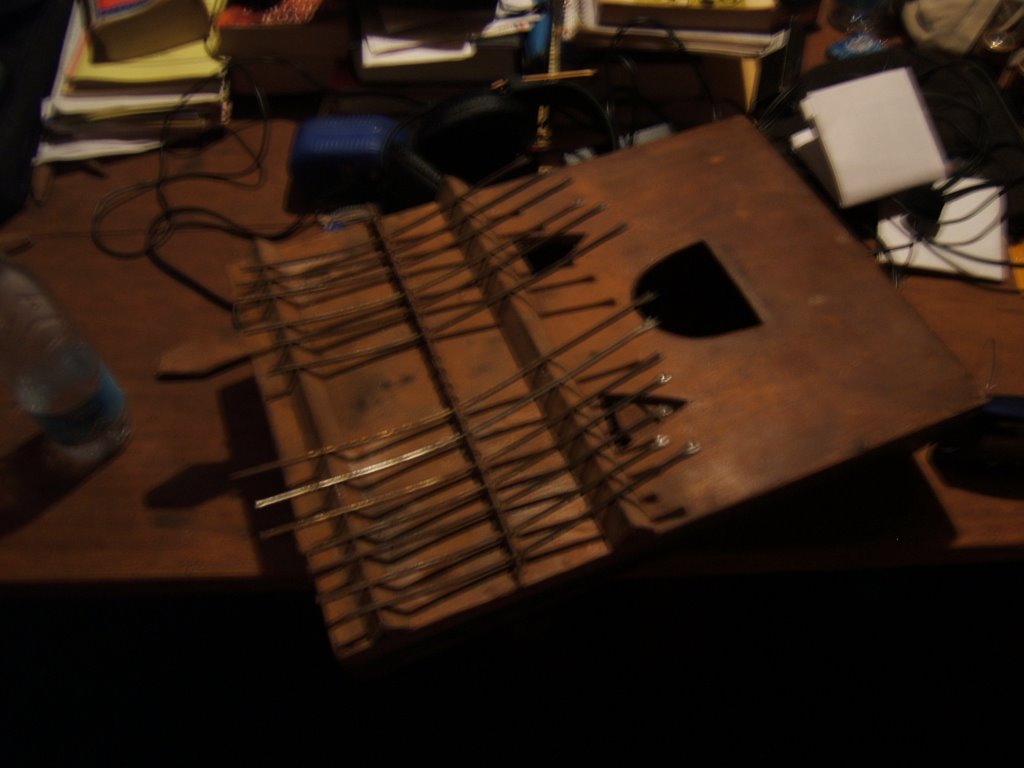
I've only been twice to this reunion, so generalizations are tentative, but the ensemble consists of 3 or 4 kalimbas, a pair or 2 of maracas made from tin cans, two think bamboo poles lashed together and played by 1 or 2 people with wooden sticks, and a sometimes a rough wooden pole scraped with a ring. Musicking kicks off the meeting (usually, I think). Almost everyone else dances, and there might be call and response singing. The money-talk is supposed to come after, but the second time I went, they had either done it early, or there was no controversy because everyone left once the music was finished. The first week, I stuck around for a couple of hours of debate (I had an interpreter), and left before it was finished.

The musical director is not there in any other capacity and is not interested in the money stuff, although all the other players are full members. I'll have to explain shortly that, as an anthropologist, I'm interested in the money as social context to the music. Besides, oratory and debate are great for linguistic anthropologists. The members of the reunion have been extremely welcoming, and I don't anticipate a problem with this. Let's hope I make fast progress with my language acquisition, as my Medumba is rudimentary right now.

I'm also impatient - and sometimes discouraged - about languages because lack of Medumba skill has so far prevented me from asking the right questions about music and poetry. While Medumba of course has concepts, categories, and words similar to "poetry," "song," "rhetoric," "music," "dance," and "sound" in English, they aren't organized the same way. This is precisely the sort of phenomenon I came here to look at. So, I'll keep working, but have to wait a while before getting to the heart of the matter.

At this stage, then, it looks like my project will be about sound, money, the concept of "tradition," rhetoric, and possibly multilingualism. Of course, it could change again at any time.

Monday, August 29, 2005

words and "development"


I received the following text message last week: "pour un avenir meilleur, scolarisons tous nos enfants. Message UNICEF/MTN." In English, that's: "for a better future, let's put all our children in school. From UNICEF and MTN [a cell-phone company]." Thought provoking on many levels, no?

My fellow linguistics nerds may care to know that Medumba has what are sometimes called "verbal adjectives." These are words that, based on their semantics, speakers of European languages would expect to be adjectives, but "behave like" verbs; i.e., they head clauses, are inflected for tense and aspect, take nominal complements. An example of this is the word "zi," which in free translation means "big," but in literal translation is closer to "to be big." I don't know why, but I've always found verbal adjectives fun. So far, it seems to me that colours, anyway, are adjectives, but I may have a lot more to learn about adjectives and verbs yet. We'll see.

Monday, August 15, 2005

anthropology of anthropologists


I travelled to Yaounde, Cameroon's capitol, recently to attend the annual conference of the Pan-African Anthropology Association. There were only two other linguistic anthropologists. Coincidentally, there was a Cameroonist there who's a PhD-candidate at the University of Toronto.

One of the panels was composed of chiefs from across the continent speaking on their ideas and strategies for good governance. This panel ended 4 hours late. A big part of the reason for that is that no one is in a position to say to a chief, "your time is up, we have to move on to the next speaker." Culture is everywhere.

While in the city, I splurged on a couple of moderately pricey restaurant meals. For one of them, I had pizza, which was fun. Cheese is really not available in this region except in restaurants.

Tuesday, August 02, 2005

small centre


Lately, people whom I don't think I've ever seen before have been coming up to me and coaching me in Medumba. Today, someone asked me if I was "Monsieur Simon." I was then able to overhear her and her friends confirming that I was indeed the white guy who's learning Medumba. I hope this means that Bangangte is a small enough place that word simply gets around quickly. This would make my research easier. Regardless, it's nice that people are so friendly. Not much of blogworthiness has happened lately; I'm just slowly improving my language skills.

The people who are kindly putting me up watch a lot of American movies (dubbed into French) on their VCD player. VCD is like DVD except poorer quality, and lower capacity; feature-length films require two disks. When I left the house this morning, "In Hell" starring Jean-Claude van Damme was on - not exactly my thing. "My Best Friend's Wedding" wasn't so bad, though, and I genuinely enjoyed "The Devil's Advocate" with Charlize Theron, Keanu Reeves, and Al Pacino.

Thursday, July 14, 2005

progress being made


I've (finally) begun the next phase of my language training. Mondays, Wednesdays, and Fridays I attend a class in Bangangte with four other students. There's only one other adult, and I think I'm the only one who doesn't speak any African languages. So, I'm sure to be the worst student! I also work one-on-one most weekdays (no set schedule) with one of the senior CEPOM staff. These sessions are supposed to be more academically oriented. To make things "interesting" the class uses a different writing system than the individual tutoring. So far, I'm more comfortable with the tutor's system because it encodes more details about pronunciation, and is closer to the standard transcription system familiar to professional linguists, the International Phonetic Alphabet. The other system, for example, doesn't indicate contrastive tone at all.

At the same time as my class, there's one for people who already speak Medumba, but want to become literate in it. It's explicitly aimed at reading the Christian Bible, and uses the same writing system as my class. We learned in class that there's only one other language indigenous to this part of Cameroon which has a translation of the entire thing, Shupamum. A few other languages have a New Testament.

Sunday, July 10, 2005

practicalities

As some of you know, the cost of living in Cameroon is high relative to the rest of West Africa, and that of West Africa is high relative to most of the world. Because this fact tends to be of great interest to many, I'm going to share the prices of a few things I've bought recently. The figures will be a little high for American dollars, and a little low for Canadian:

- cheap sunglasses: $2-$5
- 0.65l bottle of beer: $1
- meal before drinks at a cheap restaurant: $3
- second-hand blanket: $13
- small cup of brewed coffee: $0.20
- kilogram of coffee beans: $5.60
- 4 AA batteries, made in Cameroon: $0.50
- 4 AA batteries by Duracell: $8
- bus ticket to Douala (4-7 hours): $6
- kilogram (in a tin) of sweetened, condensed milk: $3.50
- a pineapple: $0.20

Friday, July 01, 2005

stops and starts

On Monday, I got back in touch with CEPOM, an organisation which supports and researches the indigenous language I've been learning. (It's called "Medumba" or "Bamileke-Bangangte" or some combination of those three words.) Its representative was very happy to see me again and said he and others would help me with my research by aiding with research design, giving me access to their library, and by finding contacts: this in addition to providing me with more language training.

I was meant to start all this on Tuesday, and then commence an intensive language class on July 11th. Unfortunately, on Monday night, I twisted my ankle and have been bed-ridden with a painful sprain until today.

Still limping, I went to Baffoussam to use the bank, only to have my requests turned down at every turn. So, after resting my foot a few more days, I will return to Douala to use the banks there. Cross your fingers for me! This should get me back to Bangangte in time to enroll in CEPOM's course.

While I'm trying to remain optimistic, I'm upset about how all this delays what I really want to do with these first few months of fieldwork- learn a language and a musical instrument. Institutions have never been my favourite settings, and waiting in line at an unfamiliar bank only to here "no" is difficult. So it goes.